Free & Open Source · Apple Silicon · Metal GPU

Blink. Cull. Stack.

The fastest astrophotography triage tool for macOS. Blink through hundreds of sub-exposures, find the bad ones, and move them aside — without deleting a single file.

1,457
Frames validated
99%
Automated decisions
4-Stage
Quality pipeline
14
Manual decisions needed
See It In Action

A native macOS experience, crafted for astrophotographers

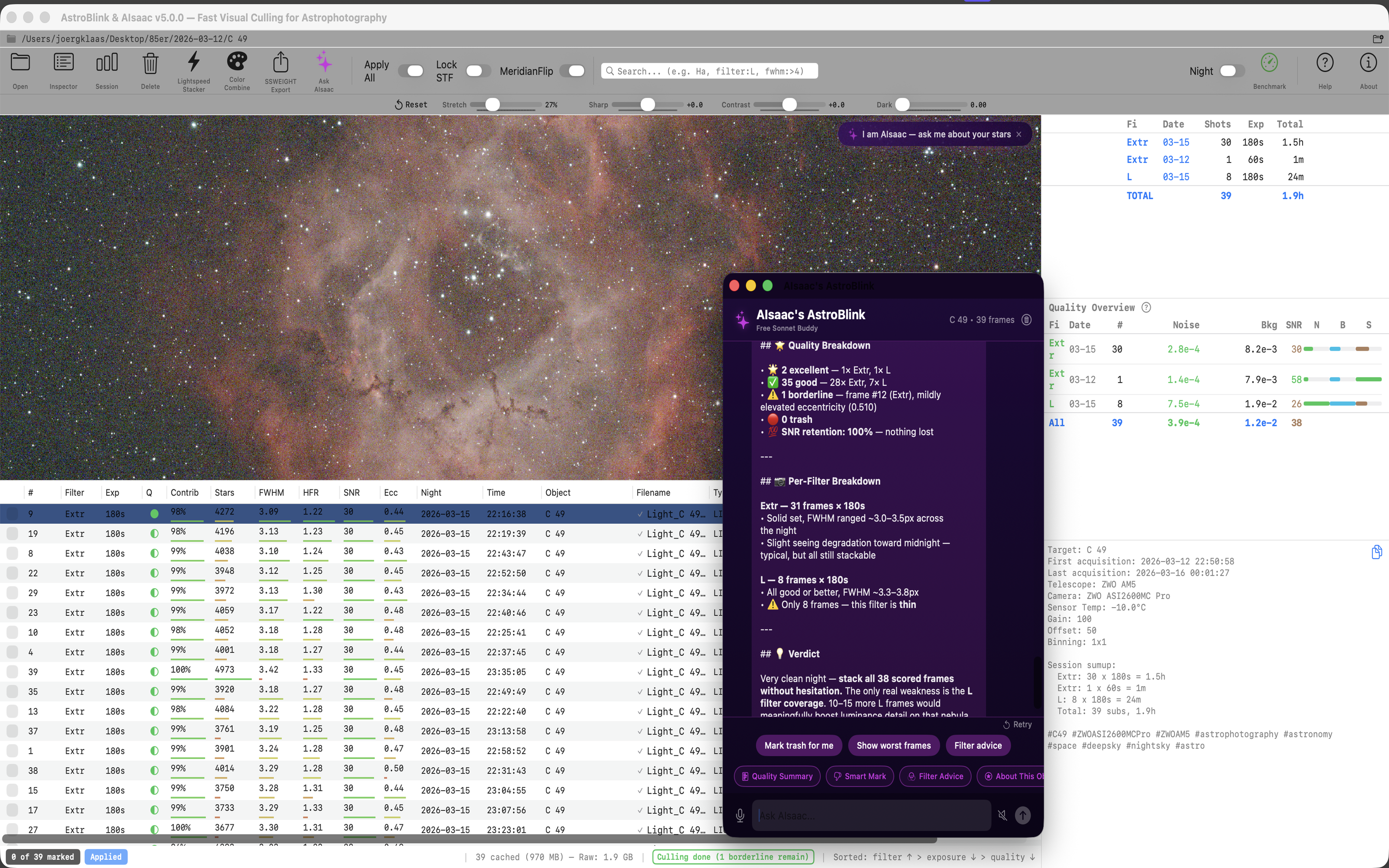
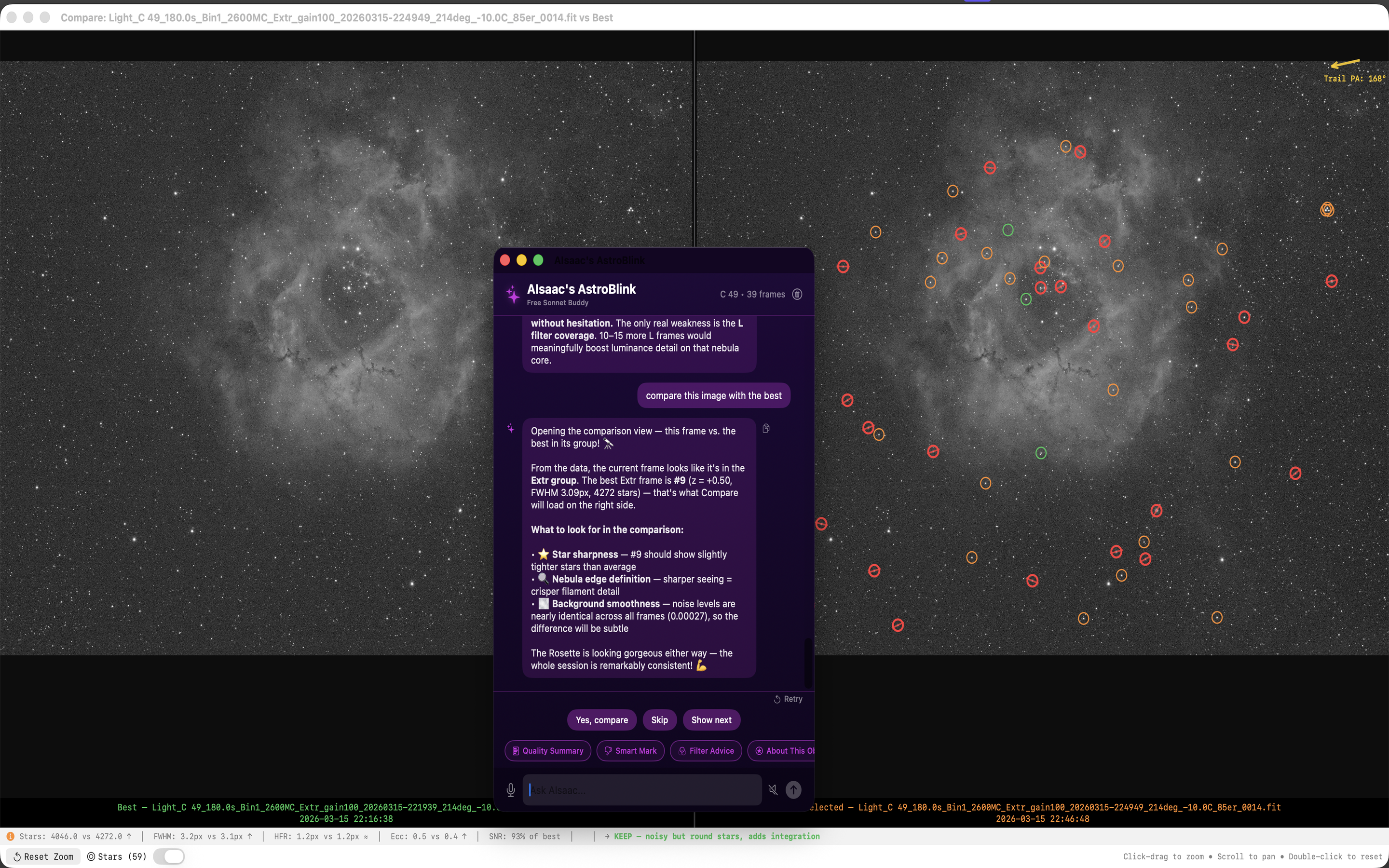
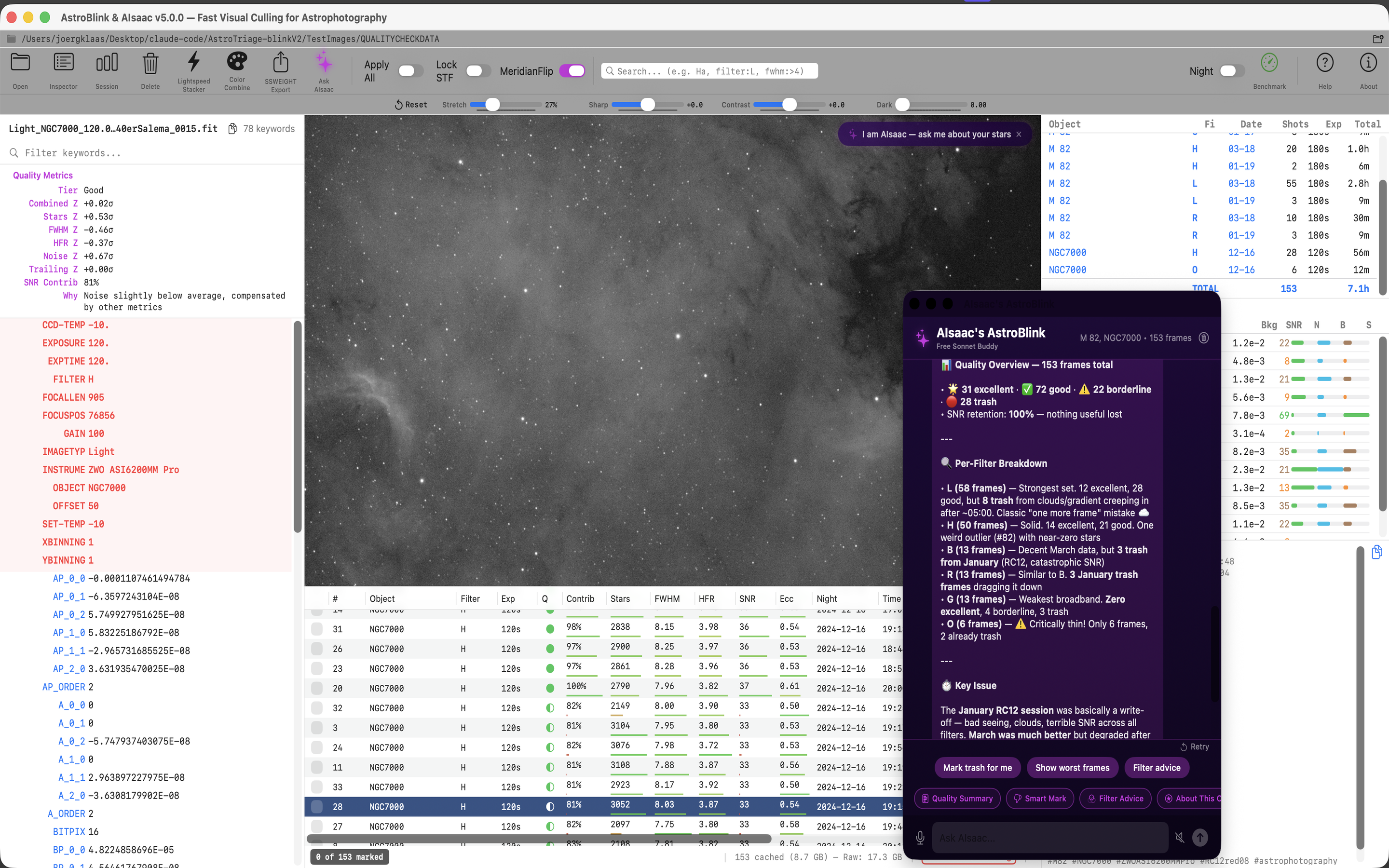
Purpose-built interface for blinking, comparing, and AI-assisted quality analysis of your sub-exposures.

AstroBlink color view with AIsaac
Color View + AIsaac
AstroBlink comparison view
Frame Comparison
AstroBlink quality analysis
Quality Analysis
Core Engine

SmartCull — 4-Stage Quality Engine

Automatically scores every sub-exposure relative to its group. Validated on 1,457 frames across 6 setups, 3 telescopes, mono + OSC, narrowband + broadband.

1

Garbage Detection

Absolute thresholds catch catastrophic failures — clouds, cable snags, tracking disasters.

2

Relative Z-Score Ranking

Robust median/MAD statistics with weighted metrics rank every frame against its peers.

3

Rescue Rules

Pattern-based rules rescue unfairly penalized frames — fewer false positives.

4

Sanity Check

Final validation ensures cull decisions are consistent and defensible.

🧭 Orientation Consensus

Detects systematic tracking errors vs. normal optical aberration using circular statistics. Distinguishes between frames with consistent elongation patterns and those with random issues.

🔄 Self-Calibration

After 30+ frames, SmartCull recalibrates its thresholds to prevent the "death spiral" — where aggressive early culls skew statistics for remaining frames.

🎛️ Culling Autopilot

Choose Conservative, Balanced, or Aggressive modes. SmartCull handles 99% of quality decisions automatically.

1,457 frames. 14 decisions.

SmartCull handles the rest. Spend your time imaging, not pixel-peeping.

AI-Powered

AIsaac — Your AI Astrophotography Assistant

Named after Isaac Newton. Powered by Claude (Anthropic). AIsaac has deep access to your session data and can both analyze and control AstroBlink via natural language.

🔬 Deep Data Access

FWHM, HFR, star count, noise, eccentricity, trailing score, quality reasoning, full FITS headers

🎤 Voice I/O

Offline speech on Apple Silicon — talk to AIsaac hands-free at the scope

🌍 Multilingual

Auto-detects language from FITS coordinates — speaks your language, wherever you image

🔧 Equipment Memory

Learns your setup over time — knows your gear, your sky, your patterns

🎯 App Control

"Show me #42", "Mark the worst 5", "Stack the best 7" — natural language control

🔒 Privacy-First

No personal data sent — only technical metadata. Your images stay yours.

💬 Preset Questions
Quality Summary — instant session overview
Smart Mark — AI-driven frame selection
Filter Advice — optimize your filter strategy
About This Object — deep-sky context
Nearby Objects — what else is up tonight
Plan Tonight — imaging plan for your location
⚡ Natural Language Control
"Show me the three worst Hα subs"
Showing frames #87, #142, #203 — high trailing scores detected during meridian flip window.
"Stack the best 80%"
Selecting 116 of 145 frames based on SmartCull quality scores.
FREE TIER
Sonnet Buddy
20 queries per day
PRO TIER
Opus Superexpert
Bring your own API key
By The Numbers

Engineered for real-world astrophotography

1,457
Frames validated across 6 setups
4
Stage quality pipeline
99%
Automated cull decisions
3
Autopilot modes
Free & Open

Built by the community, for the community

AstroBlink is completely free. No subscriptions, no paywalls, no feature gates. Every astrophotographer deserves great tools — regardless of budget.

🆓

100% Free

Download from the Mac App Store at no cost. All features included — SmartCull, LightspeedStacker, SSWEIGHT export, keyboard shortcuts. No premium tier, no trial expiration.

📊

Community Benchmarking

SmartCull's quality engine was validated on 1,457 real-world frames across 6 setups, 3 telescopes, mono and OSC, narrowband and broadband — contributed and tested by the astrophotography community.

🧠

Learns From Everyone

The more setups SmartCull encounters, the smarter its calibration becomes. Community-driven learning means better culling for every telescope, every camera, every sky condition.

🔓

Open Source

Full source code on GitHub. Inspect it, improve it, adapt it. Built transparently for a community that values trust and collaboration.

🗄️

Got terabytes of old data? Run them through SmartCull.

Most astrophotographers sit on large archives of sub-exposures collected over months or years — data that was stacked with whatever seemed okay at the time. AstroBlink is fast enough to re-evaluate hundreds of subs quickly. Drop a folder of old Hα subs, let SmartCull score them, and you might find that some were dragging your final stack down. Your data doesn't expire — but your cull decisions can always improve with better tools.

See How SmartCull Works →
Join In

Help make SmartCull smarter — with your data

AstroBlink gets better the more real-world data it sees. You can help — transparently, safely, and on your terms.

How it works

1

Use AstroBlink on your subs

Just image as usual and run SmartCull. That's it — you're already generating valuable quality data.

2

Opt in to share benchmarking data

If you choose to, AstroBlink can export anonymized quality metrics — FWHM, HFR, eccentricity, star count, noise level, trailing score, sky coordinates, and SmartCull's cull decision per frame. No images. No filenames. No personal data.

3

Your data helps everyone

Aggregated community benchmarks help refine thresholds, catch edge cases, and validate SmartCull across setups nobody on the team owns. A mono ASI2600 at f/2 in Bortle 2? An OSC 294MC under city skies? Your data teaches SmartCull what "good" looks like for every combination.

🔒 What is shared

Numerical quality metrics (FWHM, HFR, noise, etc.)
Camera & telescope type
Filter type & exposure duration
SmartCull scores & decisions
Sky coordinates (RA/Dec) — for Bortle zone & seeing correlation

🚫 What is never shared

Your images or pixel data
Filenames or folder paths
Your name, email, or any personal info
Anything without your explicit opt-in

Fully transparent

The benchmarking code is open source. You can inspect exactly what gets exported before you opt in. No black boxes, no hidden telemetry. The community can verify the data pipeline end to end.

View source on GitHub →
Non-Destructive Workflow

Your files are always safe

AstroBlink never permanently deletes anything. Culled frames are moved to a _predel/ folder, fully undoable with ⌘Z.

📂

Load Your Subs

Drop a folder of FITS or XISF files. AstroBlink reads headers and extracts quality metrics instantly.

SmartCull Analyzes

The 4-stage engine scores every frame. AIsaac is ready for questions. Preview stack with LightspeedStacker.

Export & Stack

Export SSWEIGHT for PixInsight. Culled frames sit safely in _predel/ — always recoverable.

Ecosystem

Works with your existing setup

Seamless integration with the imaging and processing tools you already use.

NINA
SGP
Voyager
APT
ASIAIR
PHD2
PixInsight
.FITS
.XISF
SSWEIGHT

Stop pixel-peeping. Start imaging.

AstroBlink is completely free, open-source, and built for the astrophotography community. Download it tonight.

FAQ

Questions before you download?

Here are the most common ones. For the full FAQ, head over to the GitHub Wiki.

Yes, completely. No trial, no subscription, no feature gates. Download it from the Mac App Store for free. The AI assistant AIsaac includes 20 free queries per day with Sonnet — if you want the Opus Superexpert tier, you bring your own Anthropic API key.
Never. AstroBlink uses a fully non-destructive workflow. Culled frames are moved to a _predel/ folder next to your originals. You can undo any cull decision with Cmd+Z. Nothing is ever permanently deleted.
AstroBlink reads standard FITS and XISF files, so it works with anything that produces them — NINA, SGP, Voyager, APT, ASIAIR, and more. It also exports SSWEIGHT values for direct PixInsight integration.
SmartCull was validated on 1,457 frames across 6 different setups, 3 telescopes, mono and OSC cameras, narrowband and broadband filters. Out of those 1,457 frames, only 14 required a manual decision — everything else was handled automatically. The 4-stage pipeline with rescue rules means very few false positives.
No. AIsaac only sends technical metadata — FITS header values, quality scores, star metrics. Your actual image data never leaves your Mac. Voice recognition runs entirely offline on Apple Silicon.
AstroBlink is built from the ground up for Apple Silicon (M1 and later) with Metal GPU compute. It runs natively — no Rosetta, no emulation. This is what makes it fast: Metal-accelerated image analysis on the same chip that handles the UI.
AstroBlink is open source on GitHub. You can open issues, suggest features, or contribute directly. The SmartCull engine was shaped by community feedback and real-world testing data from astrophotographers around the world.
Read the full FAQ on GitHub Wiki →
About

Made by an astrophotographer, for astrophotographers

Hi, I'm Joerg — a software developer and astrophotographer. I built AstroBlink because I was tired of manually blinking through hundreds of subs at 2 AM after an imaging session. What started as a personal tool quickly grew into something I wanted to share with the community.

When I'm not coding or imaging, I'm usually tinkering with telescope setups, experimenting with narrowband palettes, or chasing clear skies. AstroBlink is a passion project — built in my free time, given away for free, and shaped by feedback from fellow imagers.

If you find it useful, a star on GitHub or a coffee means a lot. If you have ideas or find bugs — open an issue, I read every one.